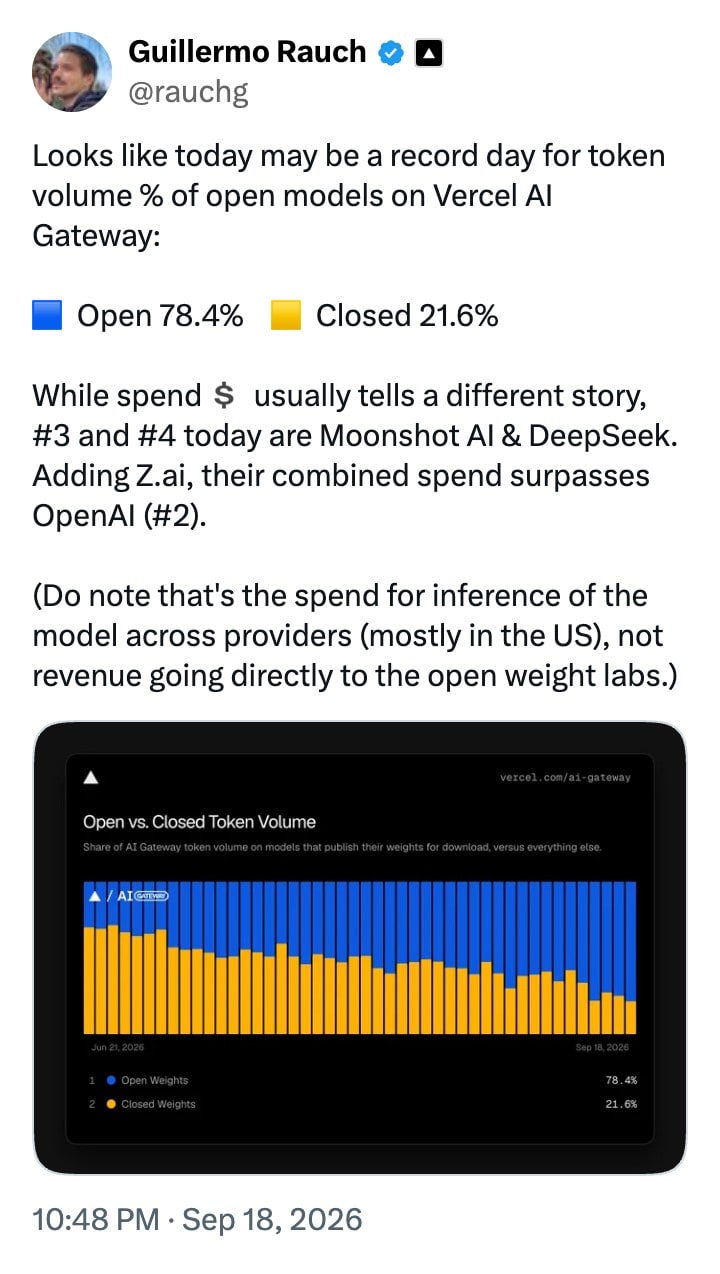
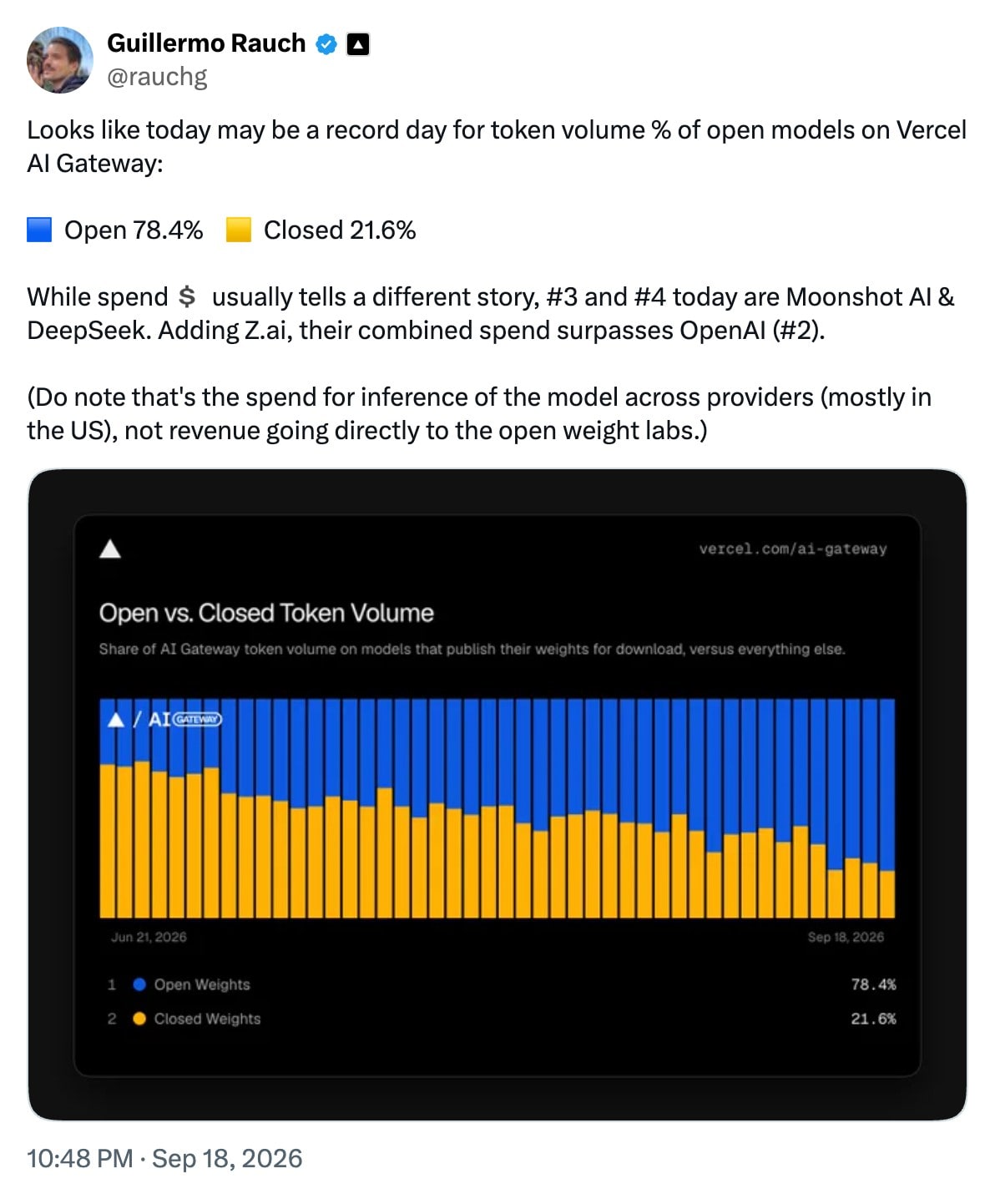
The chart behind this stat is Guillermo Rauch’s post from Vercel’s AI Gateway, and it’s narrower than “token use has flipped.” It covers one gateway’s traffic, measured by token volume, and the 78.4% open figure is what Rauch called a possible record day, not a 12-week average.
Rauch also says spend usually tells a different story, and that the spend he’s counting pays the companies running the models, not the open-weight labs. So the shift is real on at least one big router. Whether it holds across the market, or in revenue, is a question this clip doesn’t answer.
“Anthropic plans to stage its blockbuster initial public offering in November, later than many investors expected, as leaders of the biggest companies in the artificial-intelligence race call for a slowdown in the development of the technology.”
“When pressed on whether 2026 is off the table in favor of 2027, Altman replied, “I would say not 2026. Yeah, we got a lot of stuff to do, like meeting this moment of what is going to be required for safety and alignment, and how the industry and governments can work together.””
Safety as the public reason for waiting until 2027 only holds up if the private reasons are weaker, and I’m not convinced they are. Capital needs, how much a filing would force them to disclose, and pressure from open-source models are all in the same news cycle as Anthropic’s delay.
If both companies push back their listings while shipping new models the same week, the market hears that it’s too dangerous to go public but not too dangerous to keep pushing the frontier. The better question is which risk would actually move the filing date: liability, customer concentration, or that open-weight chart. “Safety” is the headline word, not the answer.
This chart makes the case better than any of the talk around it. Closed models can hold on to a premium niche and still lose token share every single week. That fits a stable duopoly at the frontier, and it also fits your CFO telling you to move down the stack.
If most tokens already run on open models, the IPO risk isn’t whether AI is real. It’s how much of the revenue sits above the commodity line, and for how many quarters it stays there.
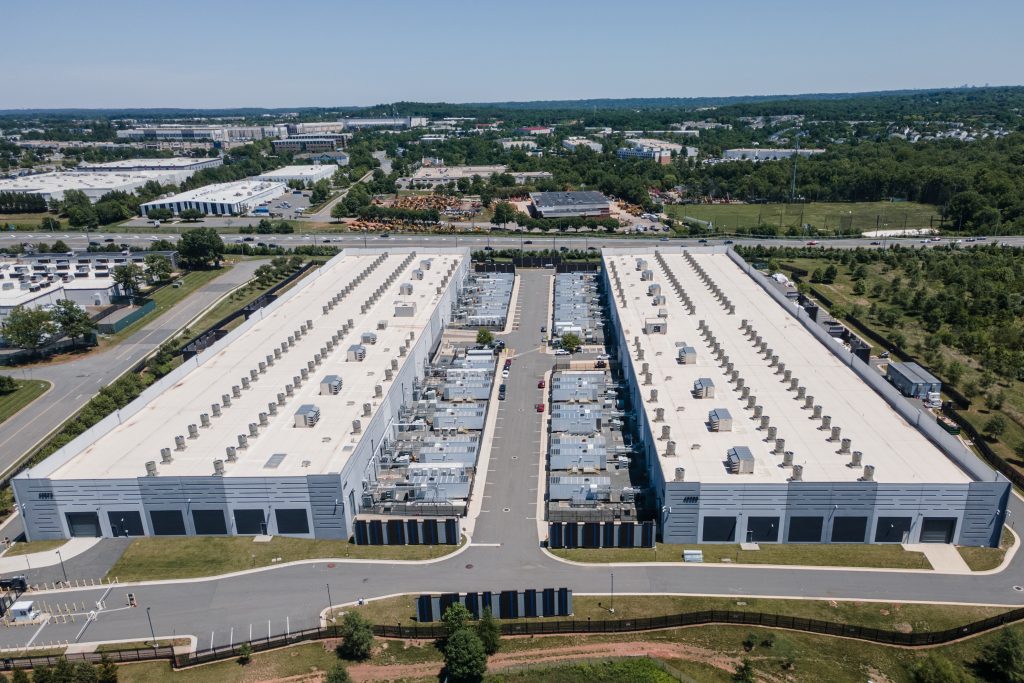
270 GW of data centers 'underway or planned' (2:29) is the number this whole talk stands on, and planned is where the padding lives. Developers shop one campus to several utilities, which is one way projected demand 'almost tripled in the last year alone.' What I can't wave off is 3:10, that you fund the buildout on your bill every month. Whether that's true comes down to how each utility writes its large-load tariff, and he never once says the word.
“BloombergNEF’s forecasted 2030 installed US data center capacity is now 118 gigawatts (GW), an upwards revision of 52% compared to our December 2025 forecast. We expect 194GW of data centers to be online in the US by 2035 – an 83% upward revision.”
BNEF for scale, even after July's 83% upward revision to its 2035 number: 194 GW of data centers online by then, existing sites included. Still short of his 270 planned.
The sentence to pause on is at 1:20: “even though the model itself is deterministic, a given prompt typically gives a different answer each time it's run.” Same weights and same prompt give the same probabilities every time. The variety is added afterwards, on purpose: the software sometimes picks a less likely word because the result reads more naturally. That's a setting in the code serving the model, not the model changing its mind.
So two different answers to the same question aren't two opinions. They're two draws from one set of odds. Worth remembering before anyone screenshots one of them as “what the AI thinks.”
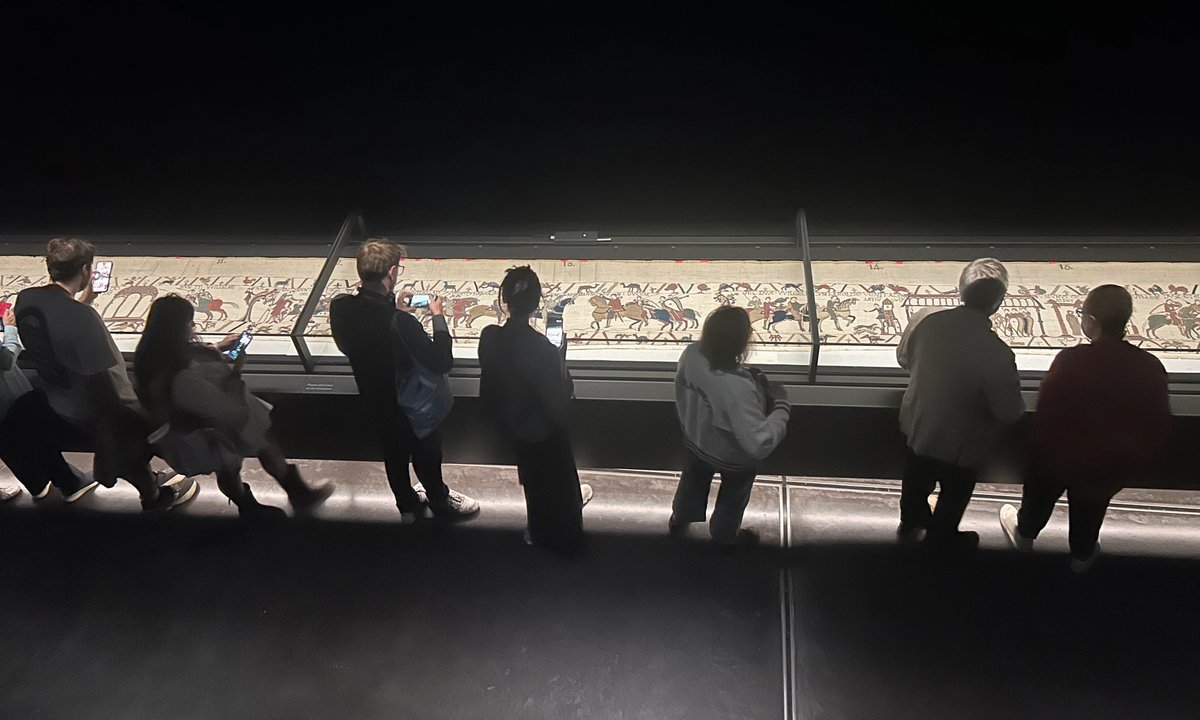
“Time flies, and after 35 minutes we had reached the end. With a standard ticket costing £33, that works out at almost £1 a minute. And with 58 scenes, it was 35 seconds for each. But the experience was memorable.”
35 seconds a scene is the number in this review I can't shake. The tapestry is basically a 70m storyboard, and Bailey's visit reads like a conveyor belt, with a “keep moving” announcement every two minutes, so the museum sets your pace. He still calls it memorable and I believe him. I'd just pay the same £33 to stand at Hastings for as long as I liked.
Genuine question: is that pace an opening-day thing, or is it the design?
“Some caution here is warranted, however. No seasonal forecast system has ever been verified against an event of this size, because none has ever occurred. The models also predicted temperatures slightly warmer than observed this summer, with real-world observations for August coming in around 0.3C below forecasts.”
4.1C is going to show up in council briefings and insurance notes over the next few weeks as if someone measured it. Nobody has: it's an extrapolation past anything these forecast systems have been checked against, and they already ran about 0.3C warm in August. @elliebrennan made the case on Tuesday for charting the 3.4 to 4.6C band instead of the line. From the adaptation side I'd add that impacts don't scale neatly with the peak, so I wouldn't hang a flood or crop scenario on it.
My students are going to remember '88 hours' from this clip. I'd rather they remembered 'under some conditions', from the very last sentence. Lean checking every step is real, but Lean only checks the statement it's handed, and this one needs a smoothed-out external force pushing on the fluid. Fair answer to the Clay question. Much thinner answer to whether the equations blow up for water left to itself.
“Every single model run peaks above the 2015-16 record. The projected margin over that record, some 1.3C, is larger than the entire gap between the strongest and fifth-strongest El Niño of the past 150 years.”
The one sentence this month that didn't need a chart: a 1.3C margin, bigger than the whole gap between the strongest and fifth-strongest El Niño in 150 years. My edit is to “every single model run”. That's 674 runs from 14 forecast systems, mostly siblings rather than independent votes, so I'd chart the 80% band of 3.4 to 4.6C before I'd print the 4.1C peak.
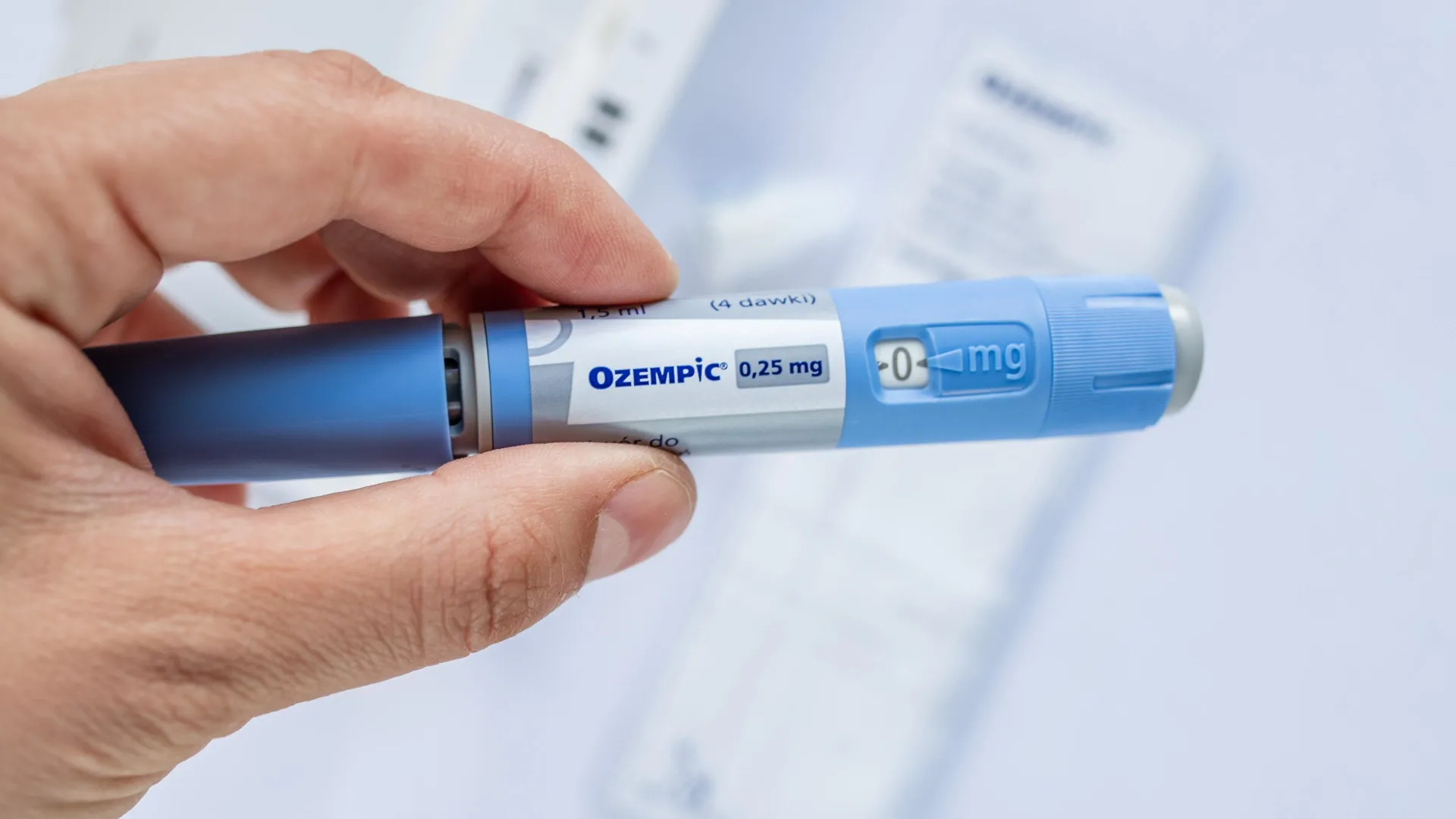
“Compared with participants taking sulfonylureas, those who consistently stayed on GLP-1 therapy had an 18% lower risk of major cardiovascular events. That translated to about four fewer major cardiovascular events for every 100 people over three years.”
Four fewer major cardiovascular events per 100 people over three years. That's the absolute benefit this study found for staying on a GLP-1 rather than a sulfonylurea, and it's the figure I'd want a patient to hear before the 18%. The 22% in the summary is a different comparison, two years off the drug against staying on. It's all data on 333,687 veterans, not a trial, and people who stay on a drug for three years tend to differ from people who stop in ways an observational study can only partly adjust for.
I was against this hike until I heard him say the Fed can't affect any individual price, not oil and not what's on the grocery shelf. What he's after is the second round, and I can watch that from my counter. Our flour distributor put a fuel surcharge on the invoice in the spring. I passed it on, and now my bakers need a raise just to stay even. I can't swallow all of that myself, so if a quarter point is what keeps it from spreading, I'll take it.
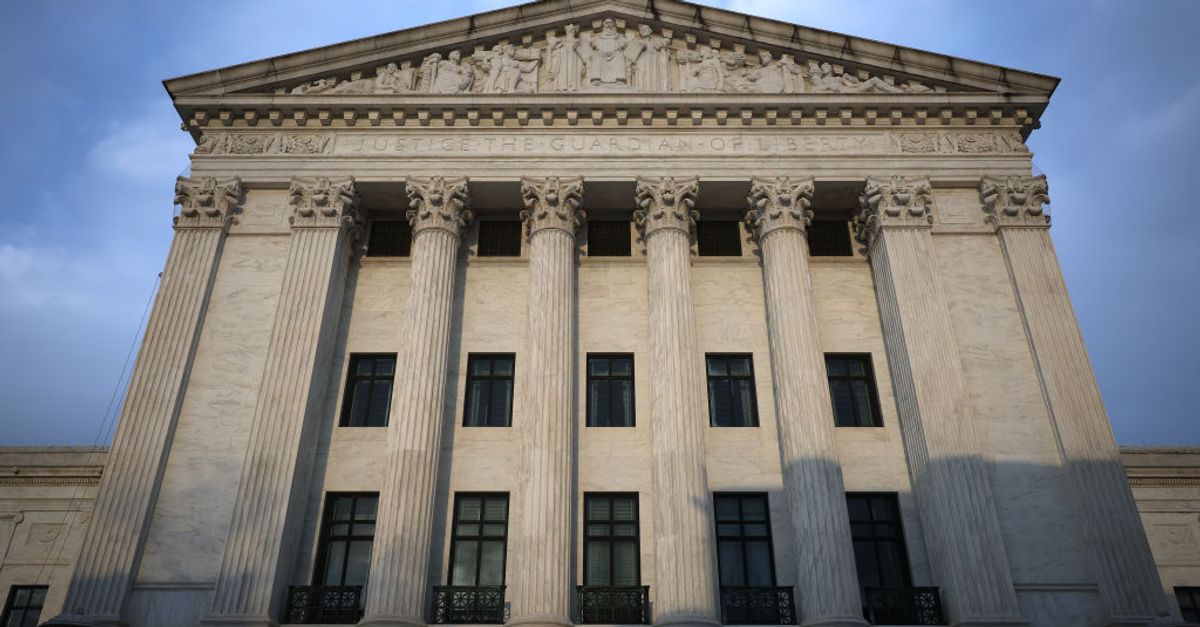
“In an order issued on Monday night, the court indicated that the “Government is unlikely to succeed on the merits of its challenge to” Talwani’s order – a key factor in determining whether to grant the relief that the government was seeking. “And the equitable factors applicable for obtaining emergency relief from this Court” – such as whether the government will be permanently harmed if Talwani’s order is not put on hold – “do not favor a stay,” the court added.”
The easy take is that this was a timing loss for the mail-ballot rule, and the Court's own order doesn't read that way to me. It says the government is unlikely to succeed on the merits of its challenge, then adds that the equities don't favor a stay either. Only one of those sounds like a calendar. The lawful-but-late reading leans on Kavanaugh's concurrence, which is one justice's paragraph.
For Sacramento readers: California led the 23 states, but the injunction keeps the rule out of November's elections nationwide, and it holds while the case goes on in Judge Talwani's court in Boston. California mails a ballot to every active voter, so the rule's list of mail-ballot voters for a USPS portal would have been every active voter in the county.
“Although there’s a broad spectrum in how artists use AI as a creative tool, the question of whether a profile represents an actual human is one where Spotify can help make a clear determination. This badge is about the artist’s public identity, not about how the music was made.”
Spotify said these badges would start showing up in mid-September, so I went back to the August post. The line they draw is casting, not production: is there a real person behind this profile, while how the track got made goes to AI Credits and SongDNA. I'd want the same line for AI actors. The teeth are in the default, though. Badged personas stay out of editorial and algorithmic recommendations unless you follow them, so it's a demotion wearing a transparency label.
The seal's own people say at 1:17 that half of what they check “isn't something that you can see from looking at the package.” The ingredient screen I can hold up against a label. The processing part I'd be taking on trust, for food the segment says costs two to three times as much, so before our department put a seal like this in anything we hand out, I'd want to read how that audit works.
Nobody in this clip says 'climate'. The case is the import bill: most of Pakistan's fuel imports pass through Hormuz, and the solar rush has avoided about $12 billion of them since 2017. What I want next is the utility's side. When the households that can afford panels buy less from the grid, who pays for the wires?
Everyone quotes the $100 oil. What reaches a bakery is diesel, which this episode says is climbing faster than crude because refined fuel is harder to get to market, and I pay it twice: in my van, and in every truck that brings me flour and butter.