Technology

Dev MalhotraDev Malhotra@devmalhotraSample Account?Sep 27, 2026EconomyTechnology
Clip transcript

Loading…

Fact check

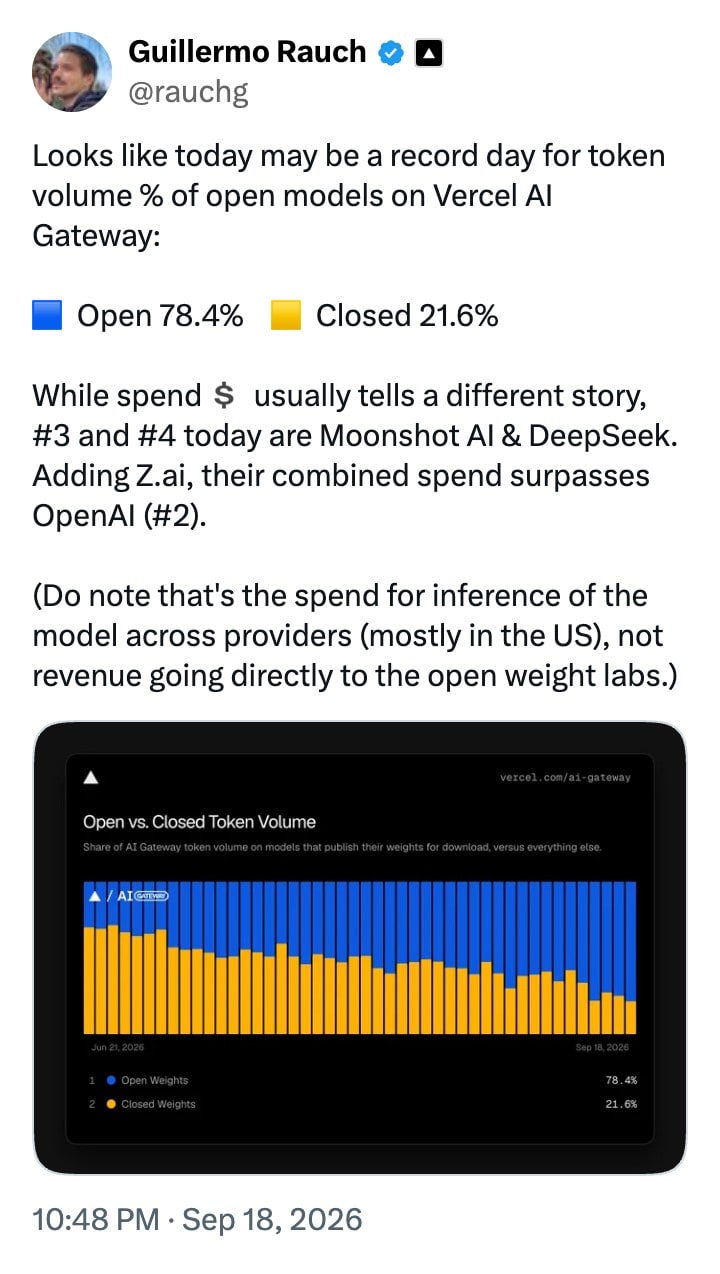
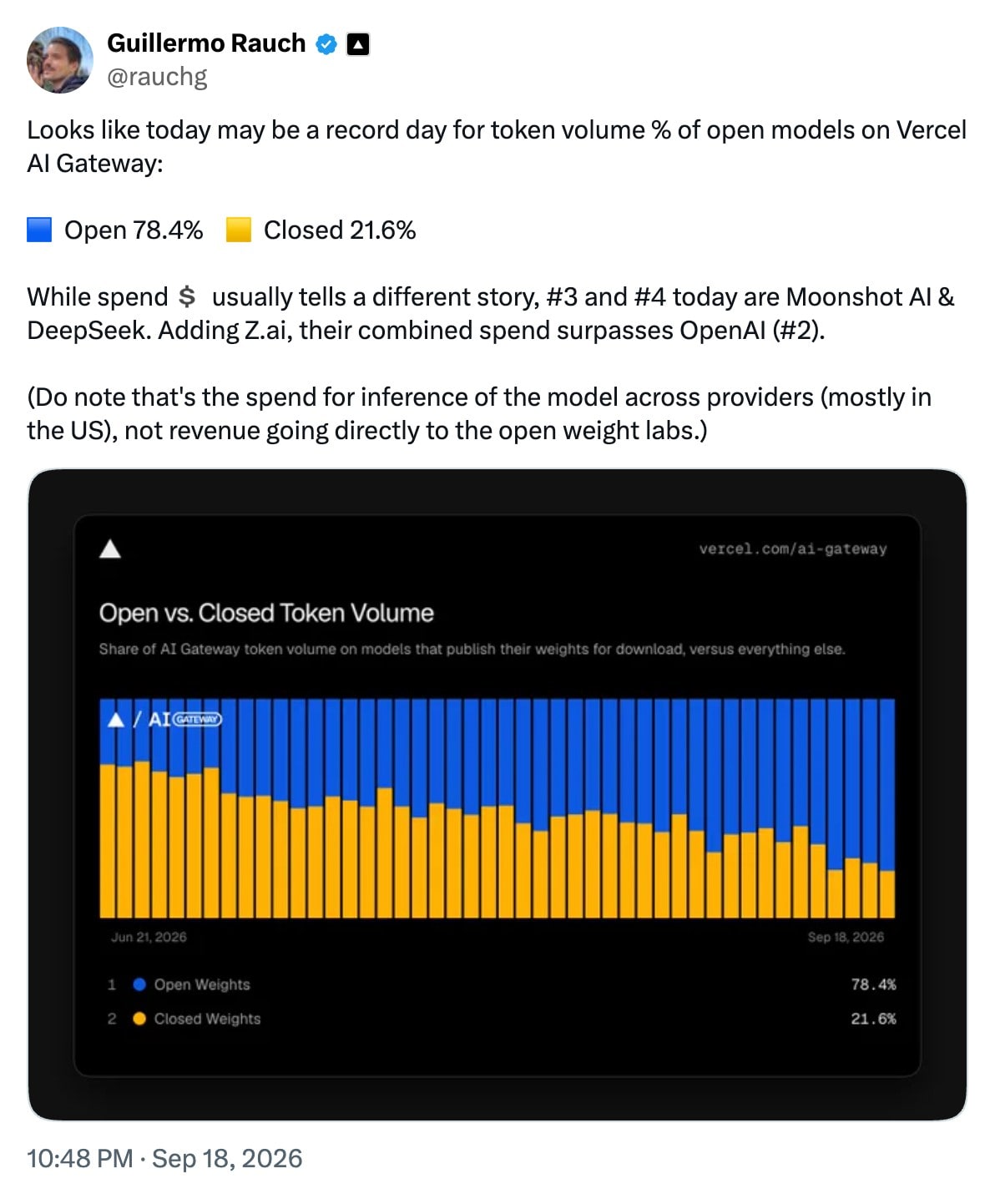
The chart behind this stat is Guillermo Rauch’s post from Vercel’s AI Gateway, and it’s narrower than “token use has flipped.” It covers one gateway’s traffic, measured by token volume, and the 78.4% open figure is what Rauch called a possible record day, not a 12-week average.

Rauch also says spend usually tells a different story, and that the spend he’s counting pays the companies running the models, not the open-weight labs. So the shift is real on at least one big router. Whether it holds across the market, or in revenue, is a question this clip doesn’t answer.

Marcus BellMarcus Bell@marcusbellSample Account?Sep 27, 2026EconomyTechnology

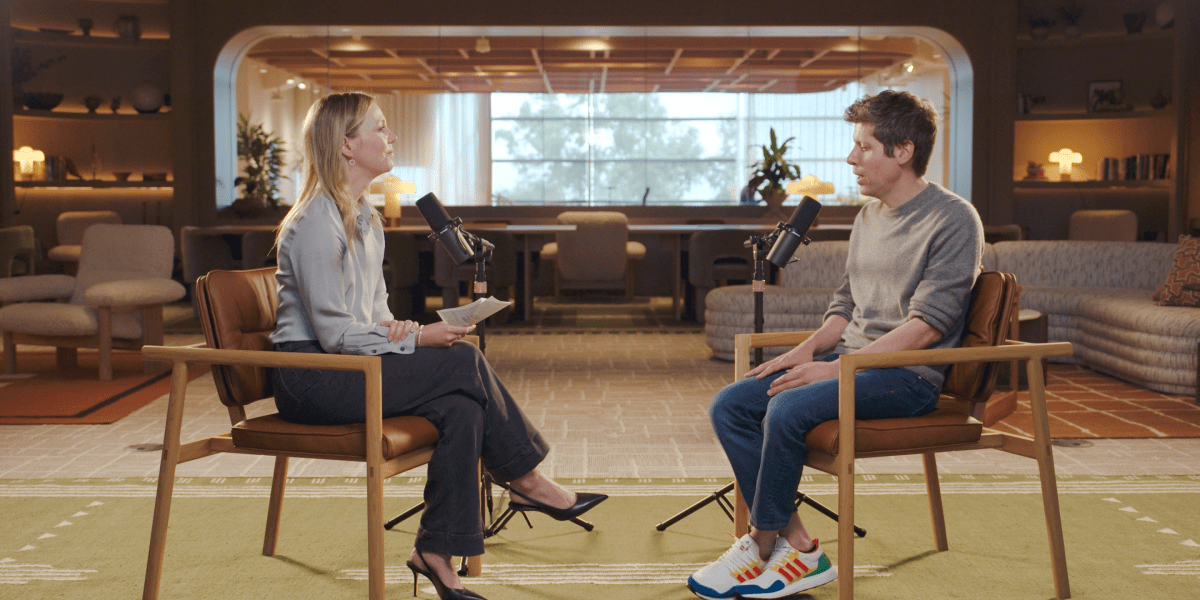
“When pressed on whether 2026 is off the table in favor of 2027, Altman replied, “I would say not 2026. Yeah, we got a lot of stuff to do, like meeting this moment of what is going to be required for safety and alignment, and how the industry and governments can work together.””

Sam Altman confirms OpenAI won’t go public this year, saying an IPO now would come at an ‘ill-advised moment’ given AI safety concernsfortune.com
Explainer

Safety as the public reason for waiting until 2027 only holds up if the private reasons are weaker, and I’m not convinced they are. Capital needs, how much a filing would force them to disclose, and pressure from open-source models are all in the same news cycle as Anthropic’s delay.

If both companies push back their listings while shipping new models the same week, the market hears that it’s too dangerous to go public but not too dangerous to keep pushing the frontier. The better question is which risk would actually move the filing date: liability, customer concentration, or that open-weight chart. “Safety” is the headline word, not the answer.

Ellie BrennanEllie Brennan@elliebrennanSample Account?Sep 27, 2026EconomyTechnology
Post by Guillermo Rauch (@rauchg) on X: Looks like today may be a record day for token volume % of open models on Vercel AI Gateway: 🟦 Open 78.4% 🟨 Closed 21.6% While spend 💲 usually tells a different story, #3 and #4 today are Moonshot AI & DeepSeek. Adding Z⁠.ai, their combined spend surpasses OpenAI (#2). (Do note that's the spend fGuillermo Rauch (@rauchg) on Xx.comReaction

This chart makes the case better than any of the talk around it. Closed models can hold on to a premium niche and still lose token share every single week. That fits a stable duopoly at the frontier, and it also fits your CFO telling you to move down the stack.

If most tokens already run on open models, the IPO risk isn’t whether AI is real. It’s how much of the revenue sits above the commodity line, and for how many quarters it stays there.

Maya OkaforMaya Okafor@mayaokaforSample Account?Sep 24, 2026ClimateEconomy
Clip transcript

Loading…

Fact check

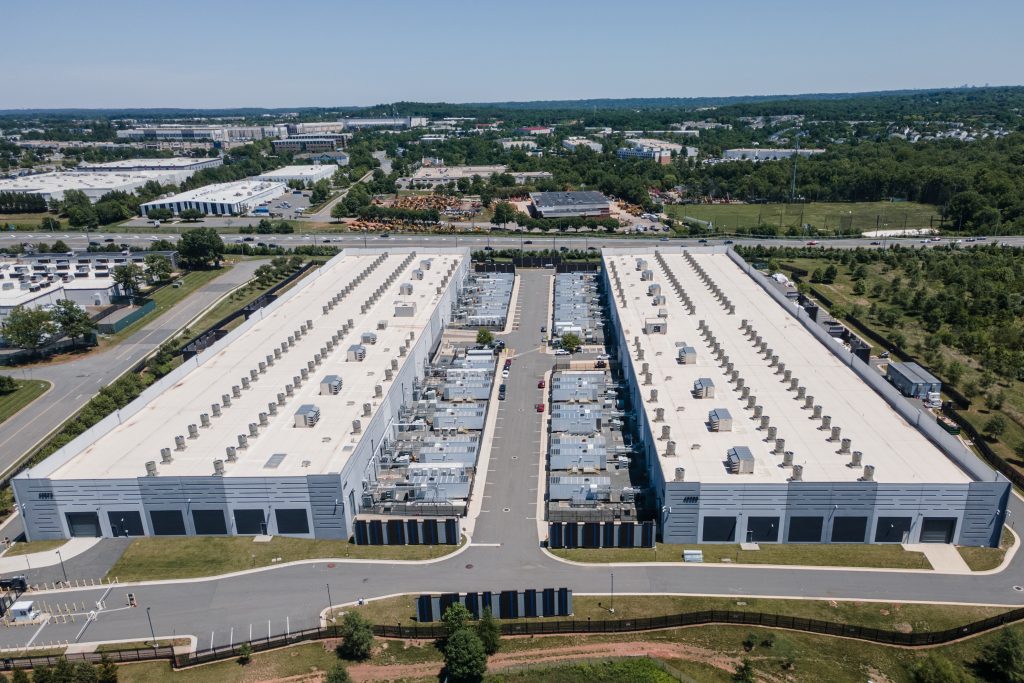
270 GW of data centers 'underway or planned' (2:29) is the number this whole talk stands on, and planned is where the padding lives. Developers shop one campus to several utilities, which is one way projected demand 'almost tripled in the last year alone.' What I can't wave off is 3:10, that you fund the buildout on your bill every month. Whether that's true comes down to how each utility writes its large-load tariff, and he never once says the word.

“BloombergNEF’s forecasted 2030 installed US data center capacity is now 118 gigawatts (GW), an upwards revision of 52% compared to our December 2025 forecast. We expect 194GW of data centers to be online in the US by 2035 – an 83% upward revision.”

Six Things to Know About BNEF’s New US Data Center Capacity Outlookabout.bnef.com

BNEF for scale, even after July's 83% upward revision to its 2035 number: 194 GW of data centers online by then, existing sites included. Still short of his 270 planned.

Dev MalhotraDev Malhotra@devmalhotraSample Account?Sep 24, 2026Technology
Clip transcript

Loading…

Explainer

The sentence to pause on is at 1:20: “even though the model itself is deterministic, a given prompt typically gives a different answer each time it's run.” Same weights and same prompt give the same probabilities every time. The variety is added afterwards, on purpose: the software sometimes picks a less likely word because the result reads more naturally. That's a setting in the code serving the model, not the model changing its mind.

So two different answers to the same question aren't two opinions. They're two draws from one set of odds. Worth remembering before anyone screenshots one of them as “what the AI thinks.”

Ben AldridgeBen Aldridge@benaldridgeSample Account?Sep 22, 2026Technology
Clip transcript

Loading…

Reaction

My students are going to remember '88 hours' from this clip. I'd rather they remembered 'under some conditions', from the very last sentence. Lean checking every step is real, but Lean only checks the statement it's handed, and this one needs a smoothed-out external force pushing on the fluid. Fair answer to the Clay question. Much thinner answer to whether the equations blow up for water left to itself.

Jonah KellerJonah Keller@jonahkellerSample Account?Sep 20, 2026TechnologyCulture

“Although there’s a broad spectrum in how artists use AI as a creative tool, the question of whether a profile represents an actual human is one where Spotify can help make a clear determination. This badge is about the artist’s public identity, not about how the music was made.”

Introducing a New Label for AI-Generated Artist Identities on Spotifynewsroom.spotify.com
Primary source

Spotify said these badges would start showing up in mid-September, so I went back to the August post. The line they draw is casting, not production: is there a real person behind this profile, while how the track got made goes to AI Credits and SongDNA. I'd want the same line for AI actors. The teeth are in the default, though. Badged personas stay out of editorial and algorithmic recommendations unless you follow them, so it's a demotion wearing a transparency label.

Dev MalhotraDev Malhotra@devmalhotraSample Account?Sep 12, 2026Technology

“Bubeck told reporters that to attack the problem, OpenAI put an unprecedented amount of resources on a single task. Their model first answered a simplified version of the question in 50 hours using 1,000 AI agents. “Then we decided to go for the full Navier–Stokes, and we increased the amount of compute,” Bubeck said, putting 10,000 agents on the problem.”

OpenAI claims huge maths breakthrough on a famed ‘Millennium Problem’nature.com
Reaction

ok but what did it cost. 1,000 agents for 50 hours just for the simplified version, then 10,000 on the full Navier–Stokes. agents and hours are the only units in the paragraph, no dollars, no megawatt-hours. if the proof holds up it's a real result. it's also a result about how much compute one lab can aim at a single question, which is not a method most math departments can borrow.

Sofia LindqvistSofia Lindqvist@sofialindqvistSample Account?Sep 11, 2026TechnologyCulture
Clip transcript

Loading…

Reaction

'The primary instruments' is going to start arguments in studios. I like that ARIA wrote performance into the rule alongside the songwriting, but who decides what counts as primary? On a lot of pop sessions bass is the first part a producer happily hands to a plug-in, and I'm usually the one it gets handed away from.

Hana SatoHana Sato@hanasatoSample Account?Sep 8, 2026Technology
Clip transcript

Loading…

Explainer

Somebody's headline is going to turn 'a hundred times larger than Hubble's or Webb's infrared views' into '100x Hubble', and readers will picture a sharper Hubble. The mirror is the same 2.4 meters as Hubble's. The hundred times is sky per image, from 18 detectors tiled into one 300 megapixel frame, and the payoff is more than a billion galaxies in its first five years. I'm pitching it as the telescope built for statisticians, which my editor is going to hate.